The Murdoch Archipelago by Page Bruce
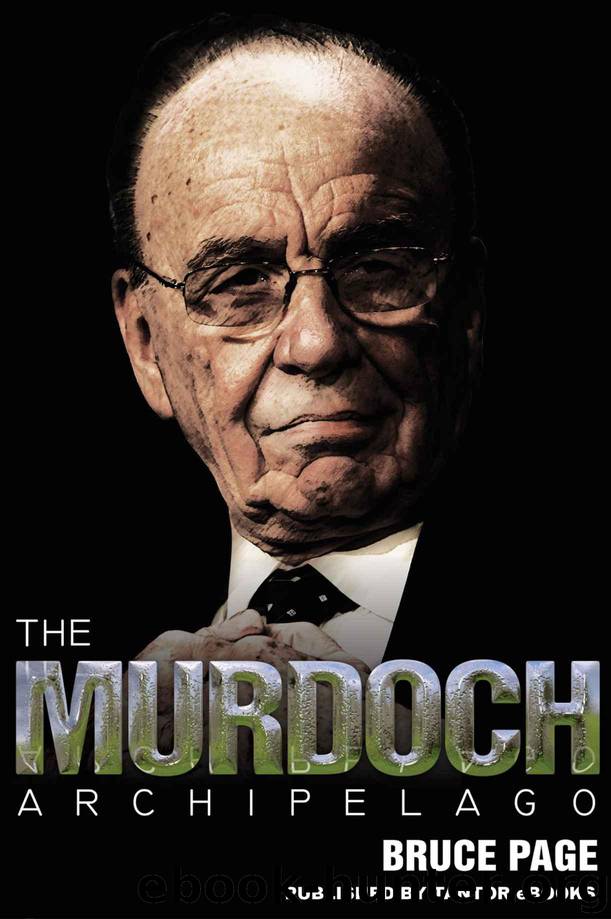
Author:Page, Bruce [Page, Bruce]
Language: eng
Format: azw3
Publisher: Tantor Media, Inc.
Published: 2013-09-17T04:00:00+00:00
11
PATRIOTIC LIKE A FOX, 1979–1985 Patriotism may be the last refuge of a scoundrel; but since all of us are to some extent scoundrels we are foolish if we get rid of our last refuge.
REBECCA WEST, The Meaning of Treason ‘I am very proud and grateful to become an American,’ said Rupert Murdoch on the morning of 4 September 1985. He had just taken the oath at the District Court in Lower Manhattan, renouncing all allegiance except to the United States of America, and promising ‘without any mental reservation’ to support its laws. The practical significance of the oath was to make Murdoch acceptable in US law as controller of the Fox television network. But it was taken also as a symbol of something new in the world: the arrival, said New York Times columnist William Sarfire, of global man, a cosmopolitan equally at home in Sydney, London and New York. If so, this wasn’t the cosmopolitanism once imaginatively linked to the brotherhood of man. Another New York columnist, Jimmy Breslin, pointed out that national antagonisms were a staple of Murdoch’s newspaper operations. By the 1980s Murdoch had become a significant figure in three systems of Anglophone national politics, and the path to American naturalisation included some complex interactions between patriotism, journalism and partisanship.
In America, a central feature of the years 1976–85 was the solid failure of the New York Post as a newspaper. This did not destroy the legend of Murdoch as a tabloid genius, perhaps because it succeeded simultaneously as a political instrument, and wiseacre minds confiate the achievements. Though the Post once sold a million during its Son of Sam period the trend line until 1981 was similar to Dorothy Schiff’s paper. The real news coverage was no better, and headlines of ‘dark playfulness’ (or brutality) didn’t alter that. The Post fascinated (and still does) the communications elite, but the columnist Pete Hamill – attracting much punitive ire – once said it was like the fascination of watching someone throw up at a dinner party. To the intelligent middle class generally the paper could not connect. Bingo, the ancient gambling game revived as Wing in 1981, added 500,000 sales. Costs, however, rose in line, and the annual loss of some $30 million did not change.
But the Post was a switch on the city’s political control panel, profitable or not, and Murdoch studied intensively to use it. When he claimed to have elected Mayor Ed Koch, Koch dutifully agreed – deferring so zealously that Murdoch was called, gratifyingly, the ‘real mayor’. No city before had made Murdoch so much at home as New York, and this accounted for the vivid (later awkward) interview in which he told Alexander Cockburn of the Village Voice that to ‘live and love’ anywhere else was unthinkable.
The relationship with Ronald Reagan didn’t match Koch’s case, but was crucial to Newscorp’s development. In 1980 the Post was intensely Reaganite. The Republican banner on an old Democratic fortress was so conspicuous that no evidence was needed for major electoral impact to be assumed.
Download
This site does not store any files on its server. We only index and link to content provided by other sites. Please contact the content providers to delete copyright contents if any and email us, we'll remove relevant links or contents immediately.
Waking Up in Heaven: A True Story of Brokenness, Heaven, and Life Again by McVea Crystal & Tresniowski Alex(37925)
Still Foolin’ ’Em by Billy Crystal(36468)
Cecilia; Or, Memoirs of an Heiress — Volume 1 by Fanny Burney(32721)
Cecilia; Or, Memoirs of an Heiress — Volume 2 by Fanny Burney(32089)
Cecilia; Or, Memoirs of an Heiress — Volume 3 by Fanny Burney(32066)
Fanny Burney by Claire Harman(26724)
Empire of the Sikhs by Patwant Singh(23205)
We're Going to Need More Wine by Gabrielle Union(19169)
Hans Sturm: A Soldier's Odyssey on the Eastern Front by Gordon Williamson(18724)
Plagued by Fire by Paul Hendrickson(17539)
Out of India by Michael Foss(17022)
All the Missing Girls by Megan Miranda(16700)
Cat's cradle by Kurt Vonnegut(15556)
For the Love of Europe by Rick Steves(14912)
Pimp by Iceberg Slim(14796)
Molly's Game by Molly Bloom(14259)
Bombshells: Glamour Girls of a Lifetime by Sullivan Steve(14217)
Leonardo da Vinci by Walter Isaacson(13512)
4 3 2 1: A Novel by Paul Auster(12612)
